 Wasting vs. Saving: Financial Literacy Lesson Plan (Grades K-2)
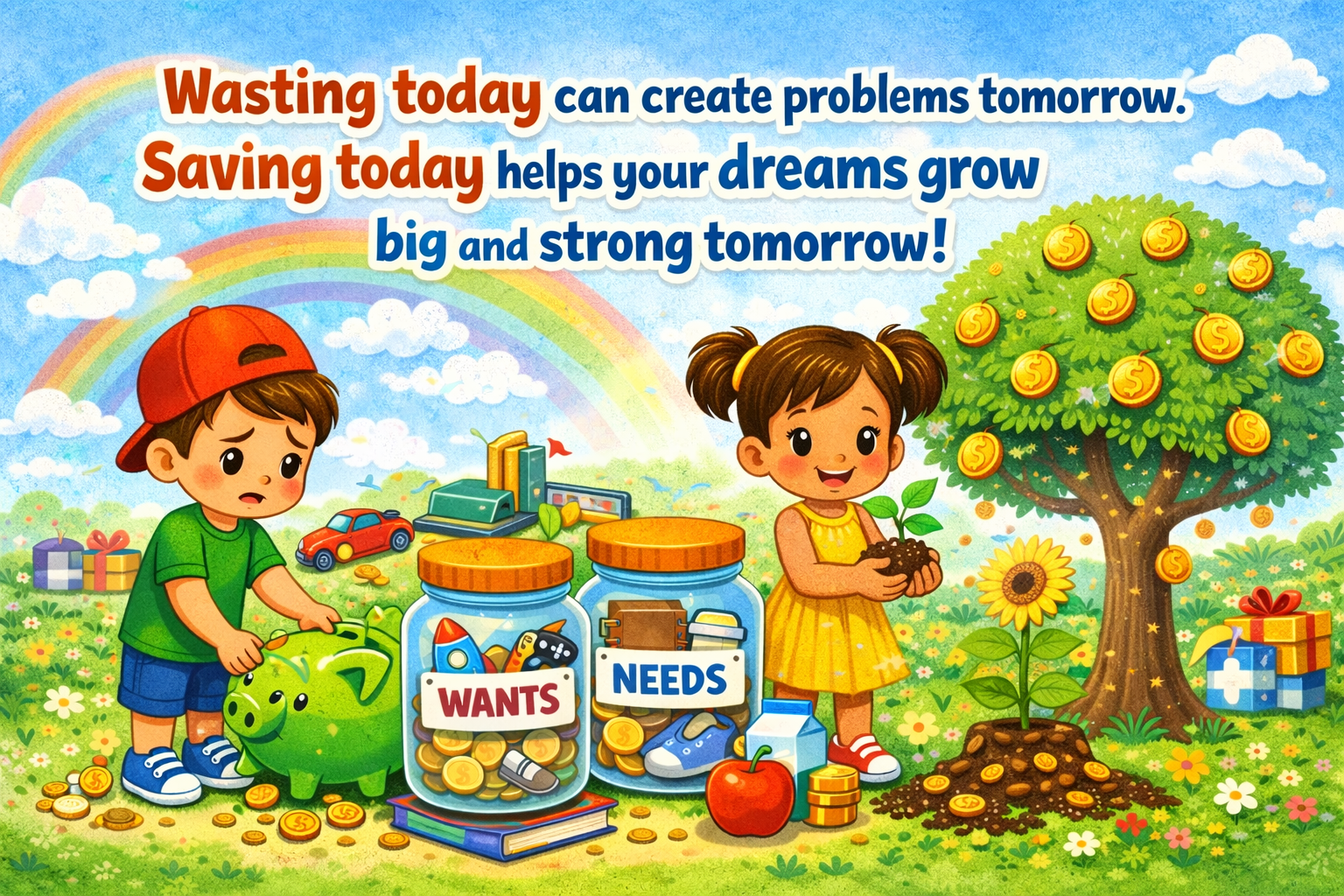
Big Idea: Wasting today creates problems tomorrow. Saving today helps dreams grow!
Lesson Overview
Concept: Scarcity & Resource Management
Time: Approximately 30 minutes
Core Habit: Don't waste limited resources
Key Phrase from Story Book: Page 6 | "Sammy, aren't you going to save what's left of those carrots instead of wasting them?"
Standards Alignment
CEE (K-4) | Jump$tart (K-2) | SEL/CASEL |
People have limited resources. | People must make choices because they cannot have everything they want. | Self-Management: impulse control. |
Saving means not spending today so you can spend later. | Saving is keeping money to use later. | Responsible Decision-Making: short- & long-term consequences. |
Learning Objectives
By the end of this lesson, students will be able to:
Explain the difference between wasting and saving in their own words.
Identify at least two consequences of wasting a resource (food, water, money, or time).
Connect saving carrots to saving money.
Give one real-life example of saving a resource at home or school.
Key Concepts
Scarcity: Resources like food, money, water, and time are limited. When we waste them, we have less for later. For young children (K-2), "saving" in this context simply means holding onto something so it is available in the future.
Saving vs. Not Spending: At K-2, "saving" means holding onto something so it's available later. You don't need to introduce interest or banking.
Why Start Habits Early: Research shows that saving habits formed early are strong predictors of financial well-being in adulthood.
Materials and Supplemental Resources
It's a Habit, Sammy Rabbit! Note: Any of the following will work: Full color story book or Read and Color Activity Story Book / Bilingual Read and Color Activity Story Book / Author Reading
Sammy Dictionary for Kids (See: Save - to keep or hold onto)
Sammy Song Series (See: Get in the Habit, S-A-V-E, The Secret, Wants and Needs, Make Your Choices Count)
Lesson Time Guide
2 min: Introduce Big Idea and story line.
5 min: Read aloud / play author reading video.
8 min: Guided Discussion (all 3 levels).
7 min: Wasting vs. Saving Sorting Game.
3 min: Transfer to Money questions.
5 min: Exit Ticket assessment.
Lesson Activities
1. Guided Discussion (8 Minutes)
Move through three levels of questions to help students process the concept:
Level 1 (Recall): What does "waste" and "save" mean? What happened because Sammy threw part of his carrots away?
Level 2 (Understand): What happens if we waste food, money, or water every day? Can you run out?
Level 3 (Apply): What is one thing you could save this week—food, water, time, or money?
2. Wasting vs. Saving Sorting Game (7 Minutes)
Use picture cards or real objects to have students sort items into "SAVE" or "WASTE" categories.
SAVE Cards:
Putting half an apple in the fridge.
Turning off the faucet while brushing teeth.
Dropping coins into a piggy bank.
Turning off lights when leaving a room.
Saving leftover dinner.
Keeping a library book safe.
WASTE Cards:
Throwing away half a sandwich.
Leaving water running while playing.
Spending all coins on candy right away.
Leaving lights on in an empty room.
Leaving food on the plate until it goes bad.
Losing a library book.
Examples of Saving: Turning off the faucet while brushing teeth, dropping coins into a piggy bank, or keeping a library book safe.
Examples of Wasting: Throwing away half a sandwich, leaving lights on in an empty room, or spending all your coins on candy right away.
3. Transfer to Money (3 Minutes)
Ask students to bridge the gap between physical resources and currency:
"If carrots were dollars, what would wasting look like?"
"If carrots were dollars, what would saving look like?"
Bonus Activity and Assessment: What Would Sammy Rabbit Say?
Purpose
Students apply what they learned about Sammy Rabbit’s character and money habits by deciding whether a statement matches his values about saving, avoiding waste, and using limited resources wisely.
Big Idea Reinforced
Smart habits help us use limited resources wisely and avoid waste.
Instructions (Teacher Script)
Say:
“In the story, Sammy Rabbit learns that saving is a great habit. He learns to collect carrots, not waste them, and think about the future.”
“Now we are going to decide if a sentence sounds like something Sammy would say. If you think he would say it, check YES. If you think he would not say it, check NO.”
Student Worksheet
Place a check by Yes or No.
Check “Yes” if you think Sammy would say the sentence.
Check “No” if you think he would not say the sentence.
Would Sammy say:
“Use what you have wisely! Smart choices today help you tomorrow.”
Yes ________ No ________“Take good care of your money and your things. They will take good care of you!”
Yes ________ No ________“Spend all your money right away. You can always get more later.”
Yes ________ No ________“Think before you spend. Wise choices are winning habits!”
Yes ________ No ________“It doesn’t matter if you waste things. There will always be plenty.”
Yes ________ No ________“Don’t waste what you have. Use it in ways that help your dreams grow.”
Yes ________ No ________“Be smart with your money, your time, and your tools. Smart habits take you far!”
Yes ________ No ________“Saving is too hard. It’s better to use everything now.”
Yes ________ No ________“Money is a tool. Use it wisely and it will help you reach your goals.”
Yes ________ No ________“Every time you make a wise choice with money, you build a strong habit!”
Yes ________ No ________
Discussion & Reflection Questions
After students respond, ask:
Why would Sammy NOT say numbers 3, 5, or 8?
What could happen if we spend everything right away?
What happens when we waste our resources?
How does saving help us feel safe and prepared?
How do smart habits help our future?
Extension (Grades 1–2 Writing or Drawing)
Complete the sentence:
“Sammy would say ________________________________ because ________________________________.”
Or draw a picture of Sammy using his carrots wisely instead of wasting them.
Differentiation and Assessment Strategies
Learner Strategies
ELL / Bilingual: Use the Bilingual Read and Color book; act out wasting/saving with real objects (carrot, coin, cup).
Needs Support: Focus on Levels 1-2 only; use a simple two-column worksheet (SAVE | WASTE) with pre-drawn images.
Advanced: Math extension: "If Sammy had 5 carrots and wasted 2, how many did he save?"
SEL Connection
Self-Management: Practicing impulse control (urge to use now vs. save for later).
Responsible Decision-Making: Evaluating choices and considering consequences.
Assessment Exit Ticket
Standard/Support: Draw one way to SAVE and one way to WASTE.
Advanced: Draw one way to save and complete: "I save _______ so that I can _______ later."
Family Connection and Home Extension
Conversation Starters: Ask a grown-up what the family saves instead of wastes, or if they saved money as a kid.
Optional Activity: Start a "Save Jar." Every time someone saves food, water, or coins, add a mark to the jar.
Money School: Join the Money School with a FREE or Premium Membership at SammyRabbit.com/join.
 Get All Lesson Plans in One PDF
If you’d like a FREE, printable PDF with all of the national and state standards aligned financial literacy lesson plans for It's a Habit, Sammy Rabbit! contact us.
Keep Kids Learning
Keep:
kids listening, learning, singing and growing with a FREE or PREMIUM Money School Memberships.
parents, teachers, and community leaders learning and growing their financial literacy teaching skills by reading Sam X Renick's series of articles: Money Lessons Parents Should Teach Kids!
delivering financial education at home, in school, and other venues with Sammy's Dream Big Financial Education curriculum!
Contact Sammy Today!
We welcome your questions, suggestions, and ideas! Let’s connect, brainstorm, and partner to keep helping kids, families, and communities build strong financial literacy knowledge, habits, and skills—so together, we can create better and brighter futures for all.
CONNECT NOW