 Saving Is a Great Habit: Financial Literacy Lesson Plan (Grades K–2)
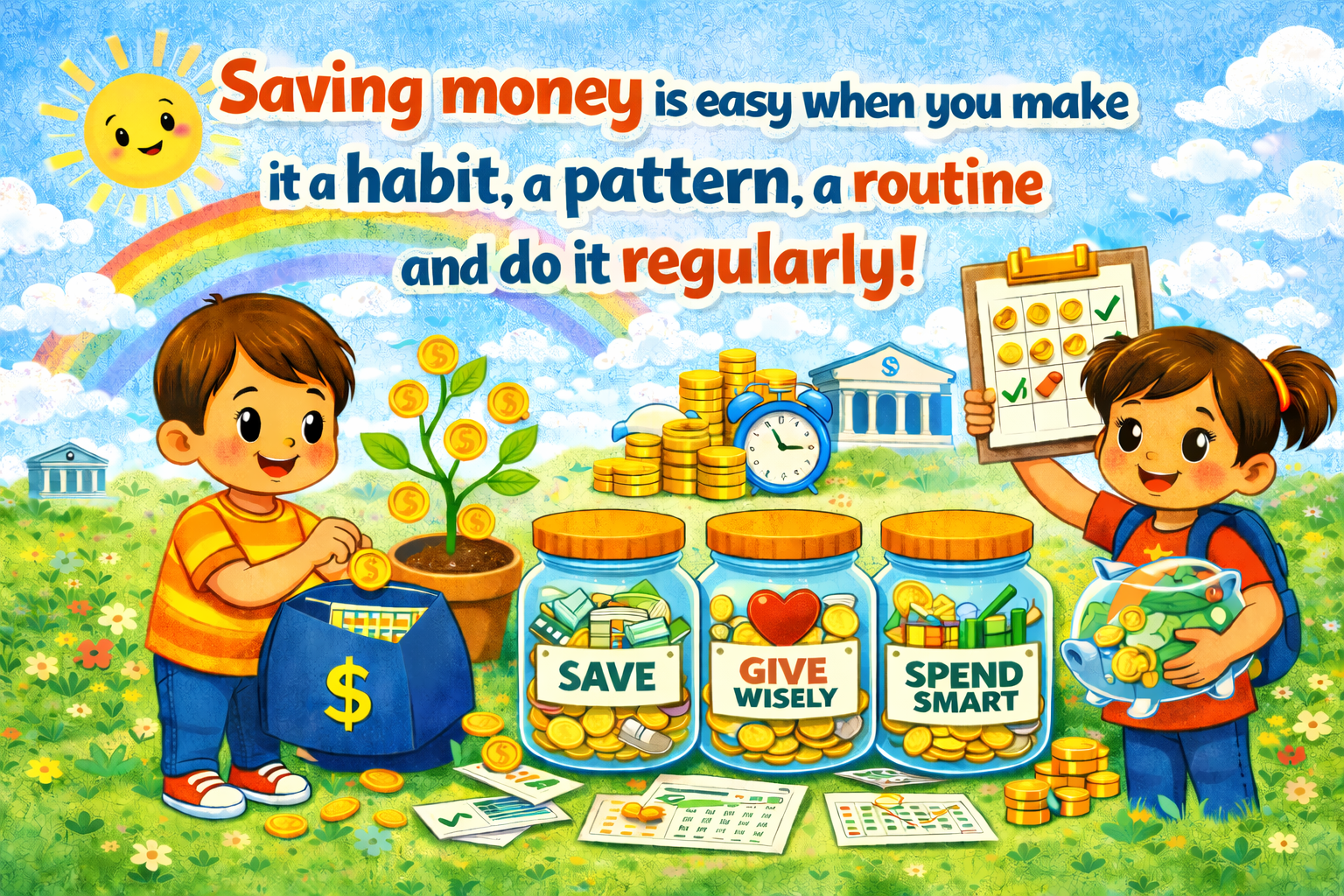
Big Idea: Saving is easy when you make it a habit — a choice you make again and again!
Lesson Overview
Concept: Habit Formation & Consistency
Time: Approximately 30 minutes
Core Habit: Save money - Do it every time you earn or receive money.
Standards Alignment
CEE (K-4) | Jump$tart (K-2 & 3-5) | SEL/CASEL |
People make choices about spending and saving. | Practice responsible money habits. | Self-Management: Impulse control and self-discipline. |
Consistent saving builds future opportunity. | Develop a plan to save money. | Responsible Decision-Making: Considering long-term consequences. |
Learning Objectives
By the end of this lesson, students will be able to:
Explain what a habit is in their own words.
Describe why saving works best when done consistently.
Identify one small way they can practice saving regularly.
Connect saving carrots in the story to saving money in real life.
Key Concepts
Habit: A habit is something you choose to do again and again. Good habits help us grow strong and successful.
Saving: Saving means keeping something now so you can use it later.
Consistency: Doing something regularly makes it easier over time.
Why Start Early: Research shows that money habits formed in early childhood are strong predictors of financial well-being later in life. When children practice saving consistently, it becomes automatic and natural.
Materials and Supplemental Resources
It's a Habit, Sammy Rabbit! Note: Any of the following will work: Full color story book or Read and Color Activity Story Book / Bilingual Read and Color Activity Story Book / Author Reading
Sammy Dictionary for Kids (See: Saving - Keep; Habit; Choice)
Sammy Song Series (See: Get in the Habit, The Secret, Make Your Choices Count)
Lesson Time Guide
2 min: Introduce Big Idea and key phrase.
5 min: Read aloud / play author reading video.
8 min: Guided Discussion (3 levels).
7 min: Habit Builder Activity.
3 min: Transfer to Money.
5 min: Exit Ticket assessment.
Lesson Activities
1. Guided Discussion (8 Minutes)
Move through three levels of questions to help students process the concept:
Level 1 (Recall):What is a habit? What did Sammy learn about saving?
Level 2 (Understand): Why is saving easier when you do it again and again? What happens if you save only once but never again?
Level 3 (Apply): What is one small thing you could save every day or every week?
How would it feel to see your savings grow?
2. Habit Builder Activity (7 Minutes)
“Again and Again” Practice Game
Explain that habits grow stronger when repeated.
Have students practice a simple saving motion:
Pretend to hold a coin.
Drop it into an imaginary jar.
Say together: “Save it!”
Repeat 5 times in rhythm to demonstrate repetition.
Then ask: “If we did this every day, what would happen?”
Optional Extension: Create a classroom “Save Jar.” Each time the class makes a good saving choice (paper, time, supplies), add a paper coin to the jar.
Examples of Habit Choices:
Saving a portion of allowance weekly.
Putting leftover food away instead of throwing it out.
Turning off lights daily when leaving the room.
Dropping coins into a jar every time money is received.
Emphasize: Small amounts saved consistently grow over time.
3. Transfer to Money (3 Minutes)
Help students bridge the story to real-world money habits:
“If carrots were money, what would saving look like?”
“What happens if you save a little bit every time you get money?”
“Why is it easier to save when it becomes a habit?”
Keep answers simple and concrete.
Bonus Activity and Assessment: Is It a Saving Habit?
Purpose
Students apply what they learned about saving as a habit by identifying which behaviors show consistent saving and which do not.
Big Idea Reinforced
Saving becomes easy and powerful when it becomes a habit — something we choose to do again and again.
Instructions (Teacher Script)
Say:
“In the story, Sammy learns from Auntie that is good idea to make saving a habit and not just something you do once. Saving is something you do again and again.”
“A habit is a choice we repeat. Now we are going to decide if each sentence shows a saving habit.”
If the sentence shows a saving habit, check YES. If it does not show a saving habit, check NO.”
Student Worksheet
Place a check by Yes or No.
Check “Yes” if the sentence shows a saving habit.
Check “No” if it does not show a saving habit.
Is this a saving habit?
“I save a little bit every time I get money.”
Yes ________ No ________“I only save when I feel like it.”
Yes ________ No ________“I put money in my savings jar every week.”
Yes ________ No ________“I spend all my money and save what is left over (if anything).”
Yes ________ No ________“I choose to save first before I spend.”
Yes ________ No ________“I saved once last year. That’s enough.”
Yes ________ No ________“I make saving part of my routine.”
Yes ________ No ________“Saving is something I try to remember sometimes.”
Yes ________ No ________“I save small amounts again and again.”
Yes ________ No ________“When I practice saving regularly, it becomes easier.”
Yes ________ No ________
Discussion & Reflection Questions
After students respond, ask:
Which sentences show saving again and again?
Why is saving once not a habit?
What makes something a habit?
Why does saving get easier when we practice it?
How can you make saving part of your routine?
Extension (Grades 1–2 Writing or Drawing)
Complete the sentence:
“Saving is a habit when I ________________________________.”
Or draw a picture of yourself practicing a saving routine (jar, piggy bank, bank visit, chart, etc.).
Differentiation and Assessment Strategies
Learner Strategies
ELL / Bilingual: Use Bilingual edition; model habit actions physically; use repetition and gestures.
Needs Support: Focus on Levels 1–2 questions. Use visuals showing repeat actions (daily calendar with coins).
Advanced: Math Extension: “If you save 1 coin every day for 5 days, how many coins do you have?”
“What if you save 2 coins each day?”
SEL Connection
Self-Management: Building routines and practicing delayed gratification.
Responsible Decision-Making: Choosing long-term benefits over short-term impulses.
Saving strengthens self-control.
Assessment – Exit Ticket
Standard/Support: Draw a picture of yourself saving something again and again.
Advanced: Complete the sentence:
“I save _______ every _______ so that I can _______.”
Family Connection and Home Extension
Conversation Starters: Ask a grown-up what habit helped them succeed.
Did they practice saving when they were young?Optional Activity: Start a “Save Every Time” jar at home. Add one coin each time money is received.
Money School: Join the Money School with a FREE or Premium Membership at SammyRabbit.com/join.
 Get All Lesson Plans in One PDF
If you’d like a FREE, printable PDF with all of the national and state standards aligned financial literacy lesson plans for It's a Habit, Sammy Rabbit! contact us.
Keep Kids Learning
Keep:
kids listening, learning, singing and growing with a FREE or PREMIUM Money School Memberships.
parents, teachers, and community leaders learning and growing their financial literacy teaching skills by reading Sam X Renick's series of articles: Money Lessons Parents Should Teach Kids!
delivering financial education at home, in school, and other venues with Sammy's Dream Big Financial Education curriculum!
Contact Sammy Today!
We welcome your questions, suggestions, and ideas! Let’s connect, brainstorm, and partner to keep helping kids, families, and communities build strong financial literacy knowledge, habits, and skills—so together, we can create better and brighter futures for all.
CONNECT NOW