 Emergency Preparedness & Savings: Financial Literacy Lesson Plan (Grades K–2)
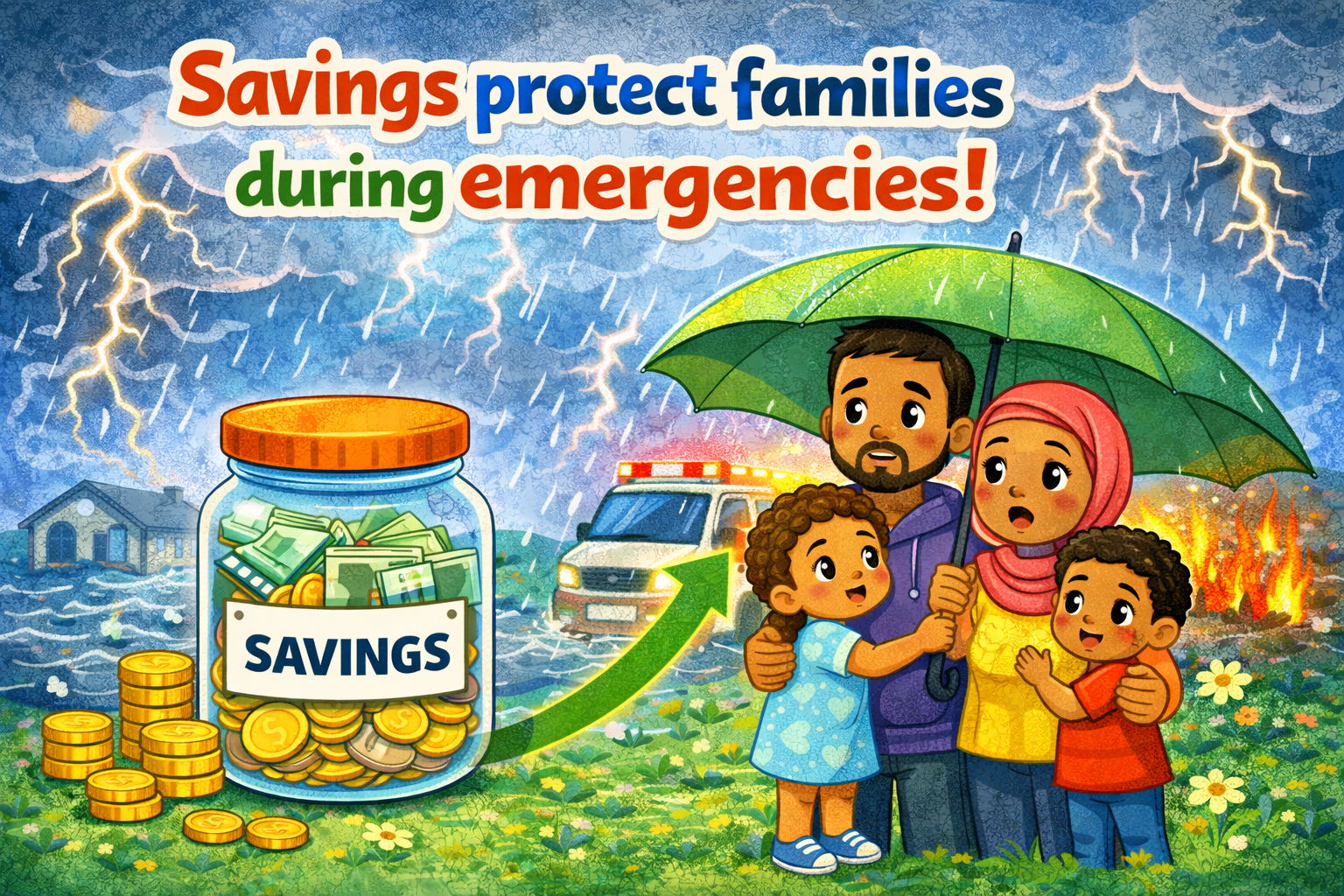
Big Idea: Savings help families feel safe, calm, and prepared for unexpected needs.
Lesson Overview
Concept: Preparedness & Emergency Savings (Planning Ahead)
Time: Approximately 30 minutes
Core Habit: Save money for emergencies.
Key Phrases from Story Book:
Page 8 | “Someday you may want or need those carrots. Wouldn't it be great if you had them then?”Page 9 | “I predict that if you get in the habit of saving, you’ll always have carrots when you want and need them...”
Page 22 | “Sammy!” exclaimed Mama. “Where did you get all those carrots?” “I’ve been saving them since Auntie shared her secret with me.”
Page 23 | “Your savings rescued the family."
Standards Alignment
CEE (3–5) | Jump$tart (3–5) |
Saving helps prepare for unexpected events. | Identify reasons for saving. |
People reduce risk by planning. | Explain the importance of emergency savings. |
Learning Objectives
By the end of this lesson, students will be able to:
Explain why saving money helps during emergencies.
Describe what an emergency is in age-appropriate terms.
Connect saving to feeling safe and prepared.
Answer the question: “How can saving money help when something unexpected happens?”
Key Concepts
Emergency: Something unexpected that needs attention right away (like a broken backpack, lost lunch money, or sudden need for supplies).
Preparedness: Being ready before something happens.
Savings: Money set aside for future needs or unexpected situations.
Security Mindset (Age-Appropriate): When we prepare ahead of time, we feel calmer, safer, and more confident.
Materials and Supplemental Resources
It's a Habit, Sammy Rabbit! Note: Any of the following will work: Full color story book or Read and Color Activity Story Book / Bilingual Read and Color Activity Story Book / Author Reading
Sammy Dictionary for Kids (See: saving; savings account)
Sammy Song Series (See: S-A-V-E)
Optional: Scenario cards (simple emergency situations written on index cards)
Lesson Time Guide
2 min: Introduce Big Idea and key phrases.
5 min: Read aloud / play author reading video.
8 min: Guided Discussion (3 levels).
7 min: Emergency Scenario Demonstration.
3 min: Transfer to Money.
5 min: Exit Ticket assessment.
Lesson Activities
1. Guided Discussion (8 Minutes)
Move through three levels of questions to help students process the concept:
Level 1 (Recall): What was Sammy saving? Why was saving important?
Level 2 (Understand): What might happen if something unexpected occurs and you have no savings? How could saving ahead help?
Level 3 (Apply): What is one small emergency you might have? How would it feel to already have money saved?
Reinforce the highlight phrase: “Saving helps us be ready.”
2. Emergency Scenario Demonstration (7 Minutes)
Visual Preparedness Activity
Use simple scenario cards to show how savings provide solutions.
Scenario 1: “Your backpack zipper breaks.”
Ask: “If you have money saved, what can you do?”
Scenario 2: “You need new school supplies.”
Ask: “How could savings help?”
Scenario 3: “You lose your water bottle.”
Ask: “What would happen if you already had money set aside?”
Place two columns on the board:
Prepared (Has Savings)
Not Prepared (No Savings)
Discuss emotional differences:
Calm vs. worried
Ready vs. stressed
Emphasize: Saving ahead helps us feel safe and prepared.
3. Transfer to Money (3 Minutes)
Bridge discussion to real-life saving:
“If you save a little each week, what could that help you with?”
“What kinds of small emergencies might families face?”
“How does saving help your whole family feel safer?”
Keep explanations simple and reassuring. The goal is understanding preparedness, not fear.
Ask: “How does being prepared change how you feel?”
Bonus Activity and Assessment: Be Ready with Savings
Purpose
Students apply what they learned by identifying whether saving would help in different unexpected situations.
Big Idea Reinforced
Saving before something happens helps you stay calm, confident, and ready.
Instructions (Teacher Script)
Say:
“Today we learned that saving money helps us be ready for unexpected things.”
“Now we are going to read some sentences. If saving ahead would help in this situation, check YES. If saving would not really make a difference, check NO.”
Student Worksheet
Place a check by Yes or No.
Check Yes if saving ahead would help in this situation.
Check No if saving would not help or is not needed.
Would saving ahead help?
“Sammy’s backpack breaks and he needs a new one.”
Yes ________ No ________“Sammy already packed his lunch and everything is fine.”
Yes ________ No ________“Sammy loses his school supplies and needs to replace them.”
Yes ________ No ________“Sammy wants to play outside and the sun is shining.”
Yes ________ No ________“Sammy’s bike tire goes flat and needs fixing.”
Yes ________ No ________“Sammy already saved money just in case something unexpected happens.”
Yes ________ No ________
Discussion & Reflection Questions
After students respond, ask:
Which situations showed that saving would help?
How does saving ahead change how you feel?
Why is it better to save before something happens?
How can saving help your family feel secure?
Extension (Grades 1–2 Writing or Drawing)
Complete the sentence:
“When I save money for emergencies, I feel _______________________________.”
Or draw a picture of yourself using savings to solve a small problem.
Differentiation and Assessment Strategies
Learner Strategies
ELL / Bilingual: Use gestures to show “worried” vs. “calm.” Repeat the phrase: “Saving helps us be ready.”
Needs Support: Use only two simple scenarios and model answers aloud.
Advanced: Ask: “If you save $2 each week for 5 weeks, how much would you have for an emergency?” Extend to longer time frames.
SEL Connection
Self-Management: Planning ahead builds confidence.
Responsible Decision-Making: Choosing to save today protects tomorrow.
Assessment – Exit Ticket
Standard/Support: Students respond orally: “How can saving money help when something unexpected happens?”
Advanced: Complete the sentence: “Saving money helps me feel ______ because ______.”
Family Connection and Home Extension
Conversation Starters: Ask a grown-up: “What is something you saved for that helped during an emergency?”
Optional Activity: Start a small “Emergency Savings Jar” at home. Encourage families to repeat the phrase: “Saving helps us be ready.”
Money School: Join the Money School with a FREE or Premium Membership at SammyRabbit.com/join.
 Get All Lesson Plans in One PDF
If you’d like a FREE, printable PDF with all of the national and state standards aligned financial literacy lesson plans for It's a Habit, Sammy Rabbit! contact us.
Keep Kids Learning
Keep:
kids listening, learning, singing and growing with a FREE or PREMIUM Money School Memberships.
parents, teachers, and community leaders learning and growing their financial literacy teaching skills by reading Sam X Renick's series of articles: Money Lessons Parents Should Teach Kids!
delivering financial education at home, in school, and other venues with Sammy's Dream Big Financial Education curriculum!
Contact Sammy Today!
We welcome your questions, suggestions, and ideas! Let’s connect, brainstorm, and partner to keep helping kids, families, and communities build strong financial literacy knowledge, habits, and skills—so together, we can create better and brighter futures for all.
CONNECT NOW