
 Counting and Tracking Your Savings: Financial Literacy Lesson Plan (Grades K–2)
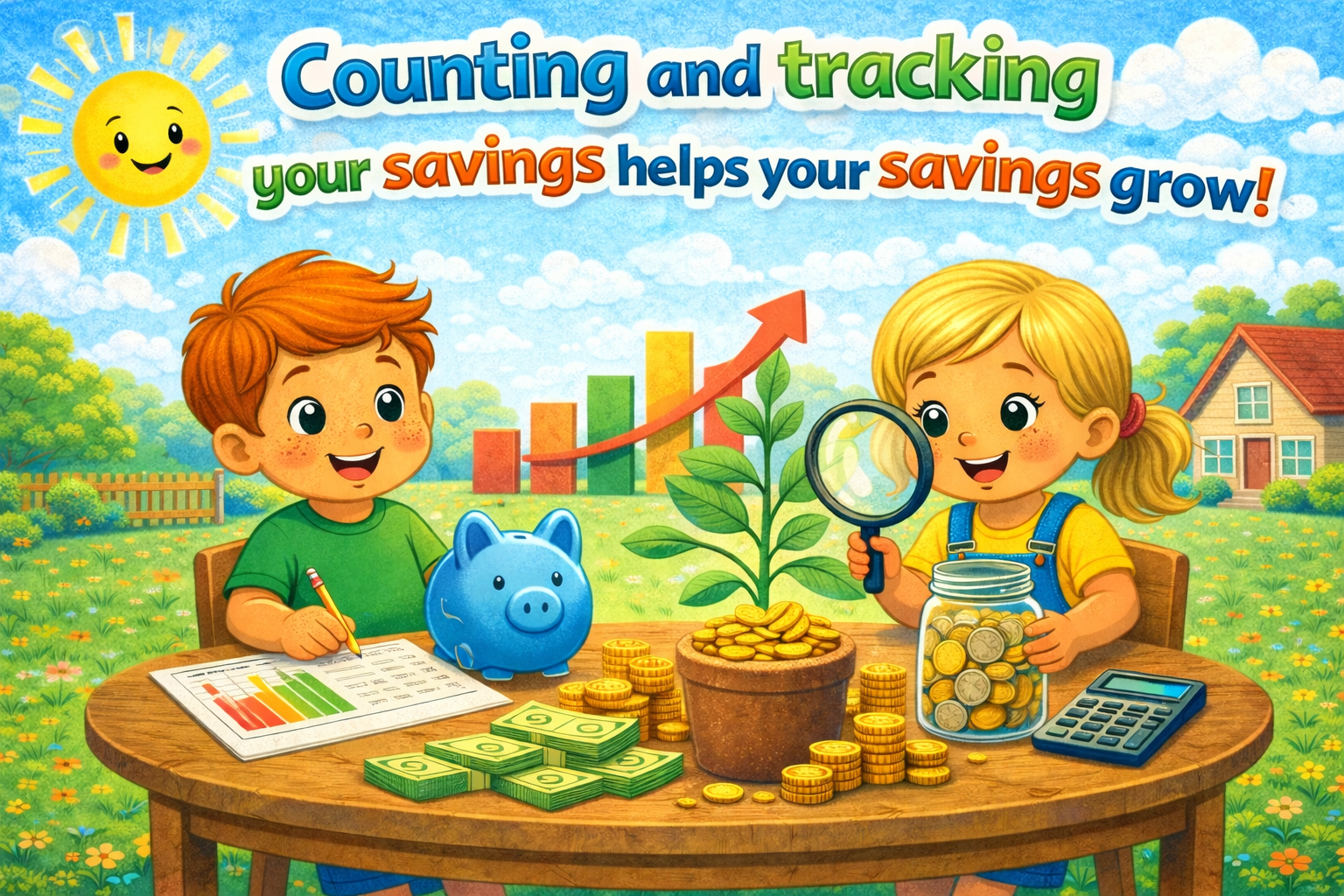
Big Idea: Counting and tracking your savings helps you see growth, build confidence, and stay motivated to save.
Lesson Overview
Concept: Tracking Savings & Monitoring Growth (Introduction to Balance Awareness)
Time: Approximately 30 minutes
Core Habit: Count and track your savings.
Key Phrases from Story Book:
Page 13 | “I would crawl under the bed and count carrots.”
Page 13 | “My savings kept getting bigger and bigger.”
Page 13 | “It was fun counting and watching my savings grow.”
Standards Alignment
CEE (K–4) | Jump$tart (K–2 / Intro 3–5) | SEL / CASEL |
People keep track of how much they save. | Recognize that saving means keeping money for later use. | Self-Management: Monitoring progress toward goals. |
Regular saving increases available resources. | Understand that money saved can increase over time. | Responsible Decision-Making: Using information to guide choices. |
Monitoring savings helps people make informed choices. | Track deposits and balances (3–5 extension). | Confidence Through Awareness. |
Learning Objectives
By the end of this lesson, students will be able to:
Understand why it is important to count and track savings.
Recognize that tracking helps them see growth.
Explain how monitoring savings builds confidence.
Answer the question: “How do I know my savings are growing?”
Key Concepts
Track: To watch and record something over time.
Count: To add up how much you have.
Balance: The amount of money you have saved.
Growth: When something gets bigger because more is added.
Ownership (Age-Appropriate): Feeling responsible for something because you pay attention to it.
Materials and Supplemental Resources
It's a Habit, Sammy Rabbit! Note: Any of the following will work: Full color story book or Read and Color Activity Story Book / Bilingual Read and Color Activity Story Book / Author Reading
Sammy Dictionary for Kids (See: save; account; balance; budget; track; manage)
Sammy Song Series (See: Get in the Habit, Budget)
Counters (paper carrots, beans, cubes)
Simple savings tracker worksheet
Lesson Time Guide
2 min: Introduce Big Idea and key phrase.
5 min: Read aloud story excerpt.
8 min: Guided Discussion (3 levels).
7 min: Watch It Grow Demonstration.
3 min: Transfer to Money and Banks.
5 min: Exit Ticket assessment.
Lesson Activities
1. Guided Discussion (8 Minutes)
Move through three levels of questions to help students process the concept:
Level 1 (Recall): What did Sammy do under the bed? What was he counting?
Level 2 (Understand): Why do you think he enjoyed counting his savings? What did he notice happening?
Level 3 (Apply): How would you feel if you counted your savings and saw it growing?
Reinforce the highlight phrase: “It was fun counting and watching my savings grow.”
2. Watch It Grow Demonstration (7 Minutes)
Visual Tracking Activity
Start with 3 carrots (or counters).
Add 2 more.
Count together.
Record the total on a simple chart.
Repeat for several rounds.
After each round, ask:
“What do you notice happening?”
“Is it staying the same or getting bigger?”
“How do we know it’s growing?”
Guide students to say:
“It’s getting bigger.”
“It grows when we add more.”
Emphasize:
“We know it’s growing because we counted and tracked it.”
3. Transfer to Money and Banks (3 Minutes)
Bridge carrots to money:
“When you save money in a bank, the bank tells you your balance. That’s like counting your carrots.”
Write the word:
Balance — the amount you have saved.
Ask:
“Why is it helpful to know your balance?”
“How might knowing your balance help you make choices?”
Keep explanations simple and concrete.
Teacher Bridge Statement:
“When children track savings, they build awareness and a sense of ownership.”
Bonus Activity and Assessment: Growing or Not Growing?
Purpose
Students apply what they learned by identifying whether tracking is happening.
Big Idea Reinforced
Counting and tracking savings helps us see growth and stay motivated.
Instructions (Teacher Script)
Say:
“Today we learned that counting and tracking helps us see our savings grow.”
“Now we will read some examples. If the person is counting and tracking their savings, check YES. If they are not paying attention, check NO.”
Student Worksheet
Place a check by Yes or No.
Check Yes if the example shows tracking savings.
Check No if it does not show tracking.
Is this tracking savings?
“Sammy counts his savings each week.”
Yes ________ No ________“Sammy never checks how much he has saved.”
Yes ________ No ________“Sammy writes down how much he saves.”
Yes ________ No ________“Sammy adds money but never counts it.”
Yes ________ No ________“Sammy checks his balance at the bank.”
Yes ________ No ________
Discussion & Reflection Questions
After students respond, ask:
Why is counting important?
How does tracking help you feel confident?
What could happen if you never checked your savings?
How does knowing your balance help you make good choices?
Extension (Grades 1–2 Writing or Drawing)
Complete the sentence:
“I know my savings are growing because _______________________________.”
Or draw your savings getting bigger and label the numbers.
Differentiation and Assessment Strategies
Learner Strategies
ELL / Bilingual: Use physical counting and number repetition. Emphasize the word “balance.”
Needs Support: Keep counting under 10 and model writing totals.
Advanced: Ask: “If you have 5 coins and add 3 more, what is your new balance?” Extend to simple word problems.
SEL Connection
Self-Management: Monitoring progress builds discipline.
Confidence Building: Seeing growth increases motivation and excitement.
Assessment – Exit Ticket
Standard/Support: Students respond orally: “How do you know your savings are growing?”
Advanced: Complete the sentence: “Tracking my savings helps me ______ because ______.”
Family Connection and Home Extension
Conversation Starters: Ask a grown-up: “How do you keep track of money?”
Optional Activity: Create a simple savings tracker at home and update it daily for one week.
Encourage families to repeat the phrase: “Counting and tracking helps savings grow.”
Money School: Join the Money School with a FREE or Premium Membership at SammyRabbit.com/join.
 Get All Lesson Plans in One PDF
If you’d like a FREE, printable PDF with all of the national and state standards aligned financial literacy lesson plans for It's a Habit, Sammy Rabbit! contact us.
Keep Kids Learning
Keep:
kids listening, learning, singing and growing with a FREE or PREMIUM Money School Memberships.
parents, teachers, and community leaders learning and growing their financial literacy teaching skills by reading Sam X Renick's series of articles: Money Lessons Parents Should Teach Kids!
delivering financial education at home, in school, and other venues with Sammy's Dream Big Financial Education curriculum!
Contact Sammy Today!
We welcome your questions, suggestions, and ideas! Let’s connect, brainstorm, and partner to keep helping kids, families, and communities build strong financial literacy knowledge, habits, and skills—so together, we can create better and brighter futures for all.
CONNECT NOW