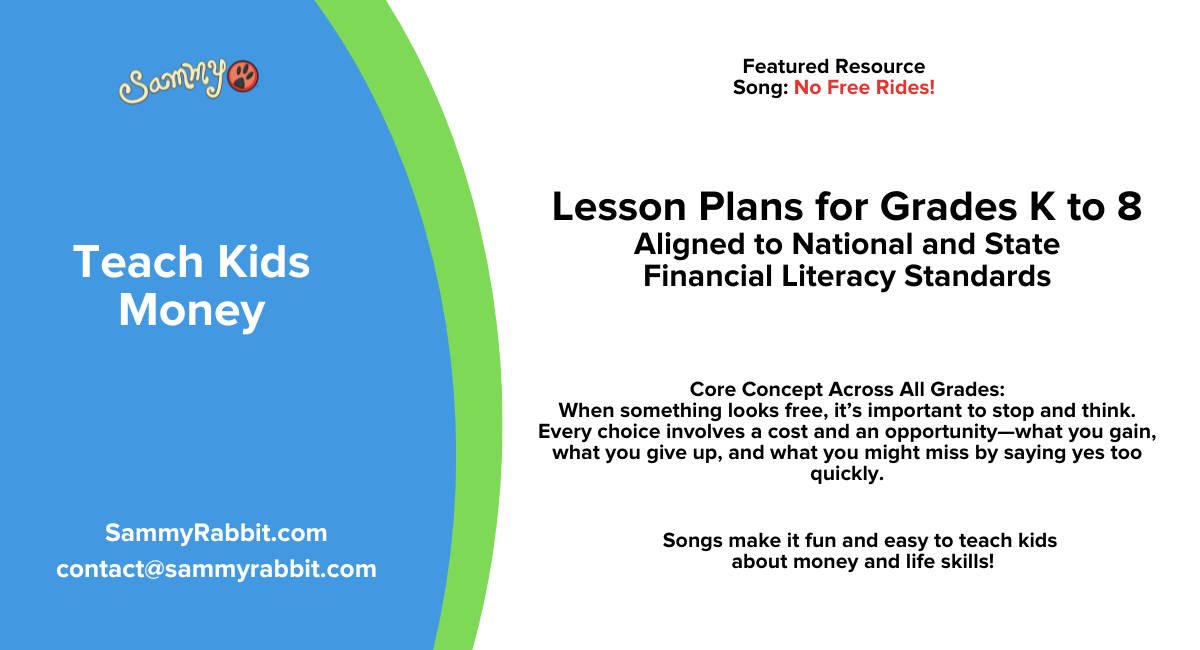
 Standards-Aligned Financial Literacy Lesson Plans on Spending Choices and Opportunity Costs. Featured Resource: Song — No Free Rides!
Core Concept Across All Grades
When something looks free, it’s important to stop and think. Every choice involves a cost and an opportunity—what you gain, what you give up, and what you might miss by saying yes too quickly.
K–2 Lesson Plan
Grade Band: K–2 (Ages 5–7)
Big Idea
Free usually means someone pays, and choosing one thing means missing another opportunity.
Learning Objective (Student-Friendly)
“I can stop and think when something sounds free.”
Standards Alignment
CEE – Decision Making: Simple cause and effect
CEE – Spending: Thoughtful spending choices
Jump$tart – Financial Decision Making: Evaluating offers
CASEL: Self-management, impulse awareness
Materials
Picture cards (free toy, free sample, gift with purchase)
Two signs or labels: FREE? and THINK FIRST
Lesson Flow (15–20 minutes)
1. Warm-Up Conversation (3 minutes)
Ask:
“Do you like free things?”
“If you choose one thing, can you choose something else at the same time?”
Explain:
“When we choose something, we give up another opportunity.”
2. Listen & Repeat (5 minutes)
Play the song and follow along with the lyrics.
Have students repeat:
“No free rides!”
Explain:
“That means we stop and think before saying yes.”
3. Guided Discussion (5 minutes)
Show a picture of a “free” item.
Ask:
“Who might be paying for this?”
“What opportunity might we miss if we choose this?”
Key idea:
“Every choice gives us something—and takes away another choice.”
4. Practice Activity (5 minutes)
Hold up picture cards.
Students respond with:
Thumbs up = stop and think
Hands on head = ask an adult
Assessment (Informal)
Students can:
Explain that free does not always mean no cost
Identify that choosing one thing means giving up another opportunity
Take-Home Connection
“When something sounds free, talk with an adult about what opportunity you might be giving up.”
Grades 3–5 Lesson Plan
Grade Band: 3–5 (Ages 8–10)
Big Idea
“Free” offers involve trade-offs and opportunities.
Learning Objective
Students will explain how “free” offers can involve hidden costs and lost opportunities.
Standards Alignment
CEE – Decision Making: Evaluating trade-offs
CEE – Spending: Intentional spending
Jump$tart – Financial Decision Making: Recognizing incentives
NFEC: Consumer awareness
CASEL: Self-control and reflection
Materials
Chart paper or board
Scenario cards (free app, free toy with purchase, free trial)
Lesson Flow (20–25 minutes)
1. Warm-Up Question (5 minutes)
Ask:
“Why would a company give something away for free?”
Introduce:
“Free is often used to get your attention.”
2. Song Analysis (5 minutes)
Play the song and review the lyrics.
Ask:
“What warning does the song give?”
“What opportunities might you give up if you say yes too fast?”
Write on the board:
Choice → Opportunity → Outcome
3. Scenario Activity (10 minutes)
Present scenarios and ask:
“What is the offer?”
“What is the trade-off?”
“What opportunity might be lost?”
Examples:
Free game → less time for homework
Free toy → less money saved
4. Reflection (5 minutes)
Students complete:
“One opportunity I might give up is…”
“One question I should ask before saying yes is…”
Assessment
Students can:
Identify trade-offs in “free” offers
Explain opportunity in their own words
Take-Home Extension
“Notice one ‘free’ offer this week and discuss the opportunity you might be giving up.”
Grades 6–8 Lesson Plan
Grade Band: 6–8 (Ages 11–13)
Big Idea
Every spending decision includes an opportunity cost.
Learning Objective
Students will analyze how “free” offers affect opportunity cost and long-term decision-making.
Standards Alignment
CEE – Decision Making: Costs, benefits, and consequences
CEE – Spending: Evaluating offers and incentives
Jump$tart – Consumer Skills: Advertising awareness
NFEC: Informed consumer behavior
CASEL: Self-management and foresight
Materials
Real-world examples (subscriptions, free trials, promotions)
Scenario comparison worksheet
Lesson Flow (30 minutes)
1. Opening Question (5 minutes)
Ask:
“Why do free trials exist?”
Discuss marketing and incentives.
2. Song Discussion (5 minutes)
Play the song and review the lyrics.
Ask:
“What is the real message of this song?”
“How does it help protect your opportunities?”
Introduce definition:
“Opportunity cost is the best thing you give up when you make a choice.”
3. Scenario Comparison (10 minutes)
Compare:
Student A accepts a free offer without thinking
Student B pauses and evaluates the opportunity cost
Ask:
“What opportunities did each student keep or lose?”
“Who has more control later?”
4. Personal Application (10 minutes)
Students write:
One ‘free’ offer they’ve seen
One opportunity they might give up
One habit that helps them pause before choosing
Assessment
Students can:
Explain opportunity cost using an example
Analyze incentives behind “free” offers
Real-World Extension
Connect to:
Digital subscriptions
In-app purchases
Advertising and social media promotions
Teacher Notes (All Grades)
Focus on thinking skills, not mistrust
Emphasize curiosity and questioning
Reinforce that opportunities matter as much as costs
Pair with Wants and Needs and Don’t Spend More Than You Make!
Bottom Line
No Free Rides helps children understand that every choice involves a cost and an opportunity—and smart money decisions begin by recognizing both before saying yes.
Get All Lesson Plans in One PDF
If you’d like a FREE, printable PDF with all of our national and state aligned financial literacy standards contact us.
Keep Kids Learning
Keep:
kids listening, learning, singing and growing with a FREE or PREMIUM Money School Memberships.
parents, teachers, and community leaders learning and growing their financial literacy teaching skills by reading Sam X Renick's series of articles: Money Lessons Parents Should Teach Kids!
delivering financial education at home, in school, and other venues with Sammy's Dream Big Financial Education curriculum!
Contact Sammy Today!
We welcome your questions, suggestions, and ideas! Let’s connect, brainstorm, and partner to keep helping kids, families, and communities build strong financial literacy knowledge, habits, and skills—so together, we can create better and brighter futures for all.
CONNECT NOW