 Teaching Third Graders That Smart Money Choices Expand Opportunity
By third grade, students are ready to think beyond simple choices.
They can compare options.
They can consider consequences.
They can think ahead.
That makes this the ideal time to strengthen this core message from Follow the Money Rules:
“Money rules are a recipe for success.”
“You’ll get to do more of the things you want to do.”
This lesson helps students understand something powerful:
Smart money choices today expand opportunities tomorrow.
Success is not accidental.
It is the result of intentional decisions.
Lesson Focus (Grade 3)
Big Idea: Thoughtful money decisions increase future opportunities.
Primary Concept:
Following money rules is a recipe for success because it leads to better outcomes over time.
Standards Alignment:
Council for Economic Education (CEE) – Decision Making
Council for Economic Education – Buying Goods and Services
Jump$tart National Standards (3–5) – Spending
CASEL – Responsible Decision-Making
Why This Matters in Third Grade
Third graders can now understand:
Money is limited.
Choices involve trade-offs.
Decisions have consequences.
This is where we introduce a powerful idea:
When you spend wisely, you increase your ability to do more later.
When students sing:
“Step by step follow the money rules…”
They begin to see that opportunity grows through disciplined decisions.
That builds long-term thinking.
Classroom Lesson Plan
Objective
Students will explain how smart spending decisions increase future opportunities.
Materials
Audio of Follow the Money Rules
Chart paper labeled: “Choices → Consequences”
Scenario cards
Student response sheet
Warm-Up Discussion (5 Minutes)
Ask:
Have you ever bought something and later wished you had saved your money?
Can spending today affect what you can do tomorrow?
Write responses on board.
Introduce the concept:
Money is limited — so choices matter.
Song Experience (5 Minutes)
Play the song.
Ask students to listen for:
“When spending money, spend smart. Make it a habit.”
“You’ll get to do more of the things you want to do.”
After listening, ask:
How can spending smart help you later?
Repeat chorus together.
Repetition strengthens internal language.
Mini-Lesson (10 Minutes)
Write on board:
Choice → Consequence → Opportunity
Example:
Spend $20 on small items → No money left for larger goal.
Save $20 → Closer to bigger goal.
Introduce simple definition:
Opportunity Cost – What you give up when you choose something else.
Explain:
Smart spending considers both today and tomorrow.
Connect back to lyric:
“Money rules are a recipe for success.”
Spending wisely is one of the key ingredients.
Activity (15 Minutes)
Provide scenario:
“You have $25.
You can buy two small toys for $25,
or save toward something that costs $50.”
Students answer:
What is the opportunity cost of buying the toys?
Which choice gives you more opportunity later?
Why?
Students complete sentence:
“A smart money choice helps me ______ because ______.”
Companion Assessment
Pre-Assessment (Before Lesson)
Short written:
What is a good money choice?
If you spend money on one thing, can you use it for something else?
Can today’s choices change tomorrow’s opportunities?
Teacher notes:
Awareness of trade-offs
Understanding of cause and effect
Post-Assessment (After Lesson)
Part 1 – Scenario Question
Ava has $15.
She spends it all on snacks.
Can she also use that $15 to buy a book later?
Yes / No
Why?
Expected:
No — she already spent it.
Part 2 – Short Response
Students complete:
“Following money rules helps me do more of what I want because ______.”
Look for:
I save for goals
I make smart choices
I think before spending
I plan ahead
What Success Looks Like
By the end of this lesson, students should:
Understand that money decisions involve trade-offs.
Connect thoughtful spending to increased opportunity.
Explain how smart choices build success over time.
Most importantly…
They begin to pause before spending.
That pause — that moment of thinking — is where opportunity is protected.
And protected opportunity leads to empowerment.
Extending the Habit
Throughout the week, teachers can ask:
“Did your choice today increase or decrease your future opportunities?”
Encourage reflection beyond money:
Time management
Homework choices
Social decisions
Financial thinking strengthens overall decision-making skills.
And when students understand that their choices shape their future, they act with greater intention.
That intention is the foundation of lasting success.
Contact Sam Today!
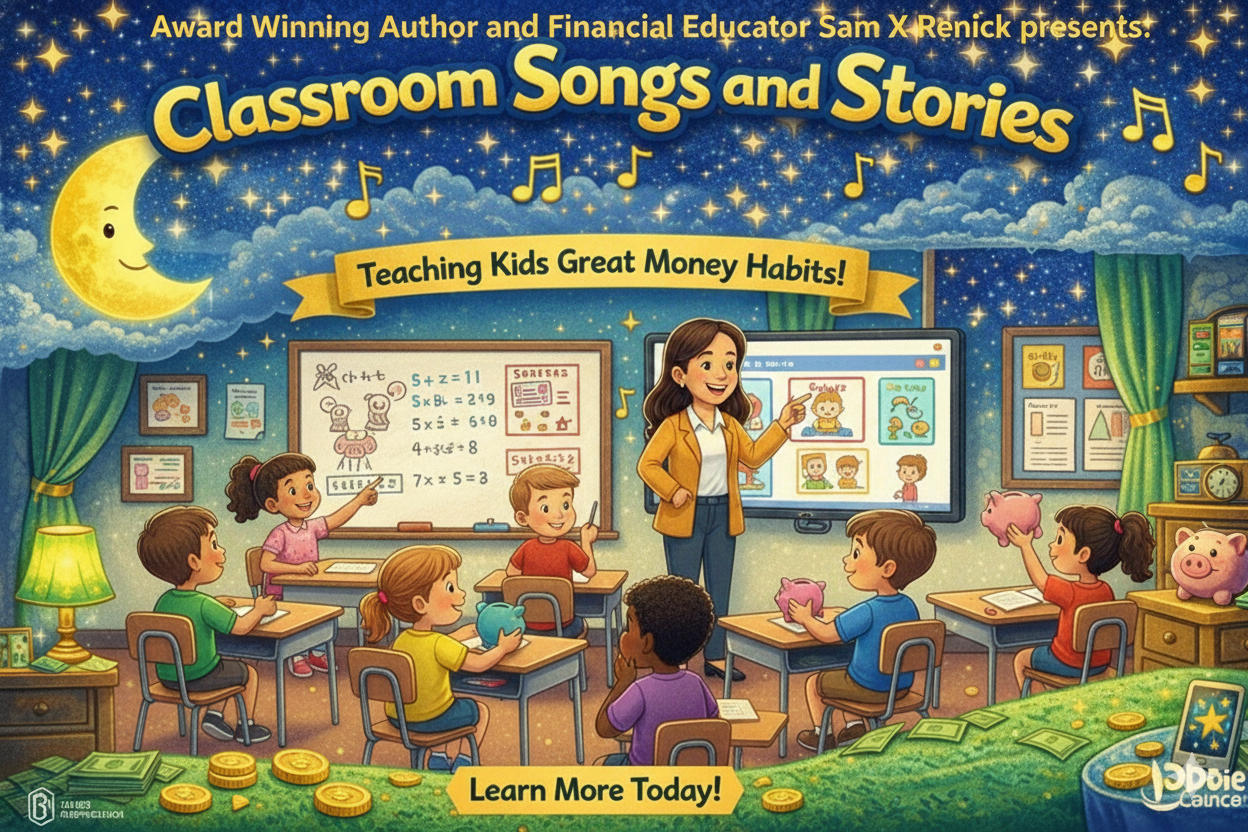
Discover more about Sam's latest initiative: Classroom Songs and Stories: Teaching Kids Great Money Habits!
CONNECT NOW!