 Teaching First Graders That Good Money Choices Help Their Dreams Come True
By first grade, children are beginning to think more intentionally about the future. They are starting to understand that what they do today can shape what happens tomorrow.
That’s one reason why this line from the song Follow the Money Rules is so meaningful:
“You’ll get to do more of the things you want to do.”
When students truly hear and reflect on that message, something powerful happens.
They begin to see that following money rules isn’t about being told “no.” It’s about creating more “yes” in their future.
And when good money choices are connected to a dream that truly matters to them, it can become a powerful motivator; one that can make all the difference in building strong habits, especially those that require patience and delayed gratification.
Good money choices open doors. They create more opportunities. And step by step, they help dreams come true.
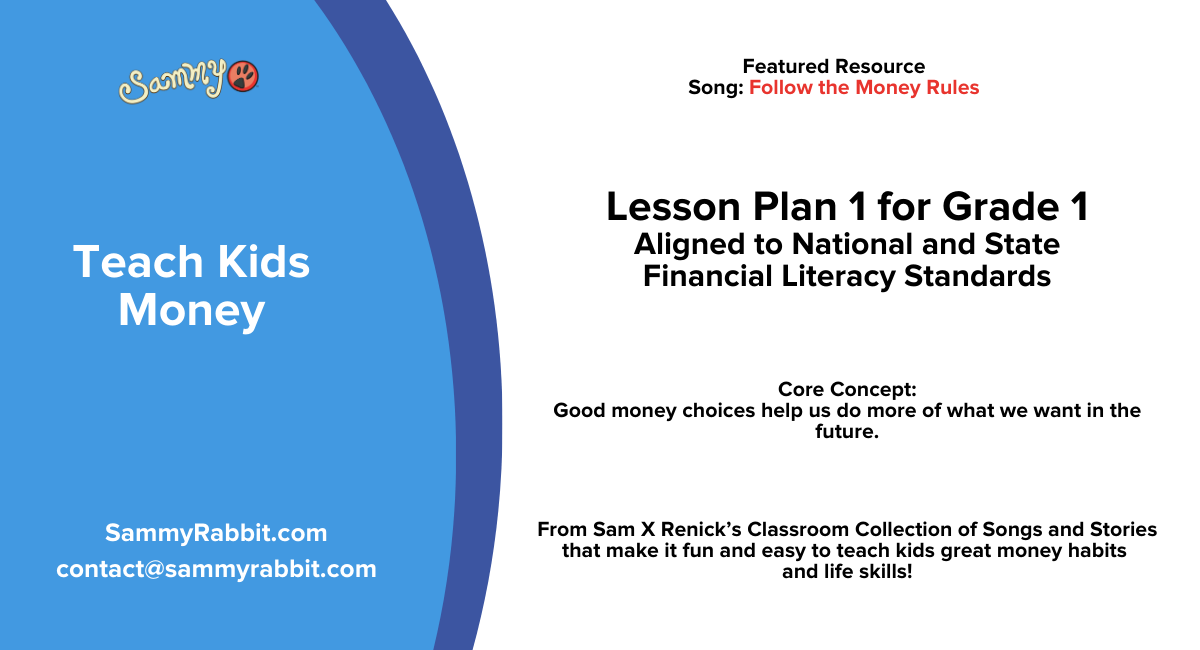
Lesson Focus (Grade 1)
Big Idea: Good money choices help us do more of what we want in the future.
Primary Concept:
Following money rules is a recipe for success.
Standards Alignment:
Council for Economic Education (CEE) – Buying Goods and Services
Jump$tart National Standards (K–2) – Saving
CASEL – Responsible Decision-Making & Self-Management
Why This Matters in First Grade
First graders are goal-oriented.
They want:
A toy
A book
A special outing
A reward
But they are still learning patience.
This lesson connects money to empowerment:
When you make good money choices, you give yourself more chances later.
When students sing:
“Step by step follow the money rules…”
They begin to understand that success is built gradually.
That idea builds confidence and cultivates patience.
Classroom Lesson Plan
Objective
Students will explain how good money choices help them reach a goal and create more opportunities.
Materials
Audio of Follow the Money Rules
Chart paper labeled: “Money Choices Help Me…”
Drawing paper and crayons
Warm-Up Discussion (5 Minutes)
Ask:
What is something you want but don’t have yet?
Can you always get what you want right away?
What might help you get it later?
Introduce the idea:
Good choices today help tomorrow.
Song Experience (5 Minutes)
Play the song.
Ask students to listen carefully for:
“You’ll get to do more of the things you want to do.”
Afterward, ask:
What do you think that means?
Repeat the chorus together.
Repetition builds internal language.
Mini-Lesson (7–10 Minutes)
Explain clearly:
A recipe helps you make something good.
Money rules are like a recipe for success.
Write on board:
Good Money Choice → More Opportunities
Example:
Spend all your money on small treats → Nothing left later.
Save some money → You can buy something bigger later.
Ask:
Which choice helps you do more of what you want?
Connect back to the song:
“Money rules are a recipe for success.”
Saving and spending smart are ingredients in that recipe.
Activity (10–15 Minutes)
Students complete two parts:
Part 1 – Draw a Goal
Draw something they want in the future.
Part 2 – Explain the Choice
Complete the sentence:
“If I follow the money rules, I can ______.”
Encourage responses like:
Save for my goal.
Buy something special.
Do more fun things.
Companion Assessment
Pre-Assessment (Before Lesson)
Short oral or written:
What is a good money choice?
Can your choices today change what happens later?
Why might someone save money?
Teacher notes:
Understanding of cause and effect
Early awareness of delayed gratification
Post-Assessment (After Lesson)
Part 1 – Multiple Choice
If you want something that costs more than you have, what should you do?
A) Spend all your money now
B) Save your money
C) Give your money away
Correct answer: B
Part 2 – Short Response
Students complete:
“Following the money rules helps me ______.”
Look for:
Reach my goals
Do more things
Save for something
Make good choices
What Success Looks Like
By the end of this lesson, students should:
Understand that money choices affect future outcomes.
Connect saving to opportunity.
See rules as helpful, not limiting.
Most importantly…
They begin to feel that they are in control of their future — even in small ways.
That feeling of control builds financial confidence.
Extending the Habit
Throughout the week, teachers can ask:
“Did your money choice today help you do more of what you want?”
Students can share examples like:
Saving part of their allowance
Waiting before buying something
Choosing wisely
The goal is not perfection.
It is awareness.
Because when children understand that their choices create opportunity, they begin to act with intention.
And intention builds success — step by step.
Contact Sam Today!
Discover more about Sam's latest initiative: Classroom Songs and Stories: Teaching Kids Great Money Habits!
CONNECT NOW!